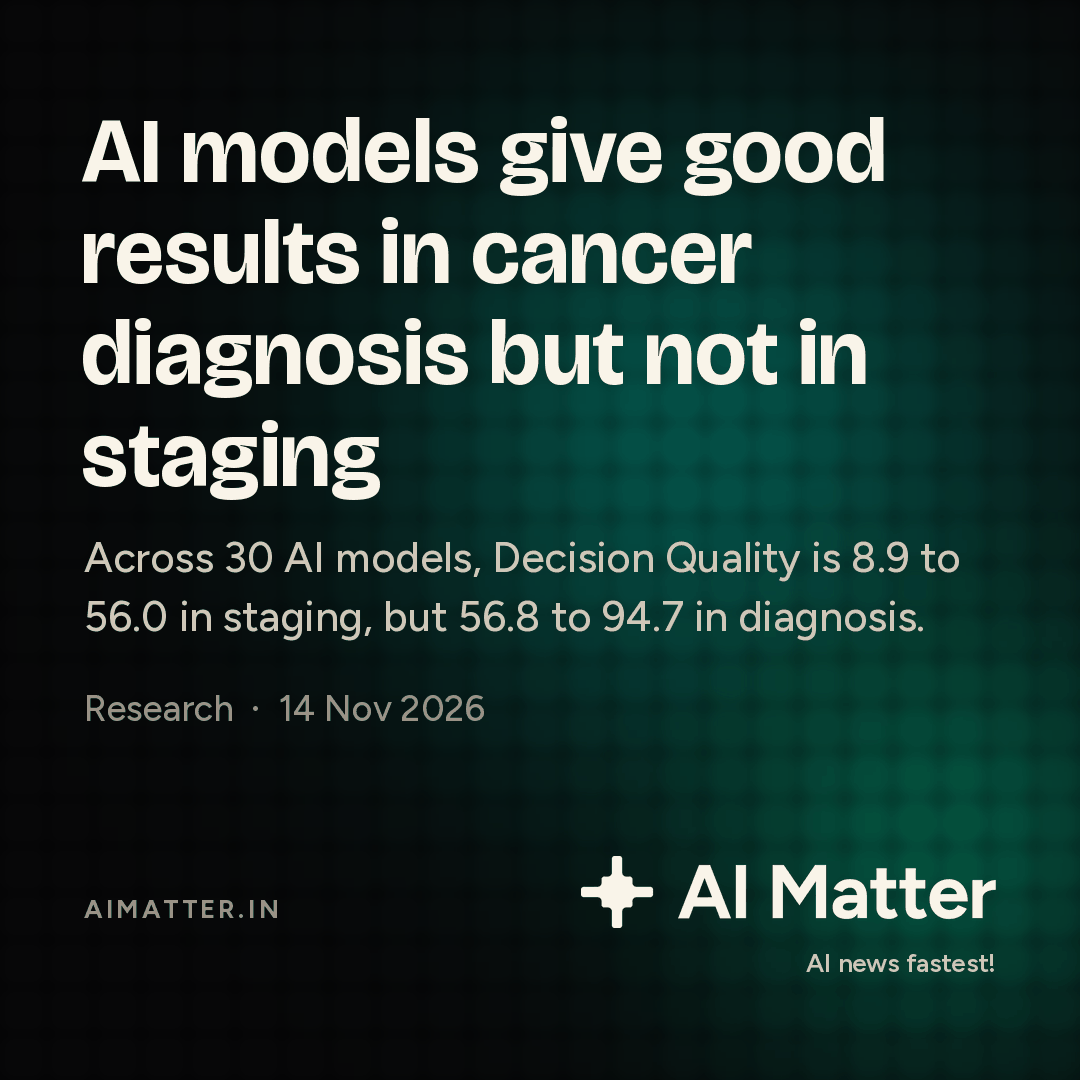
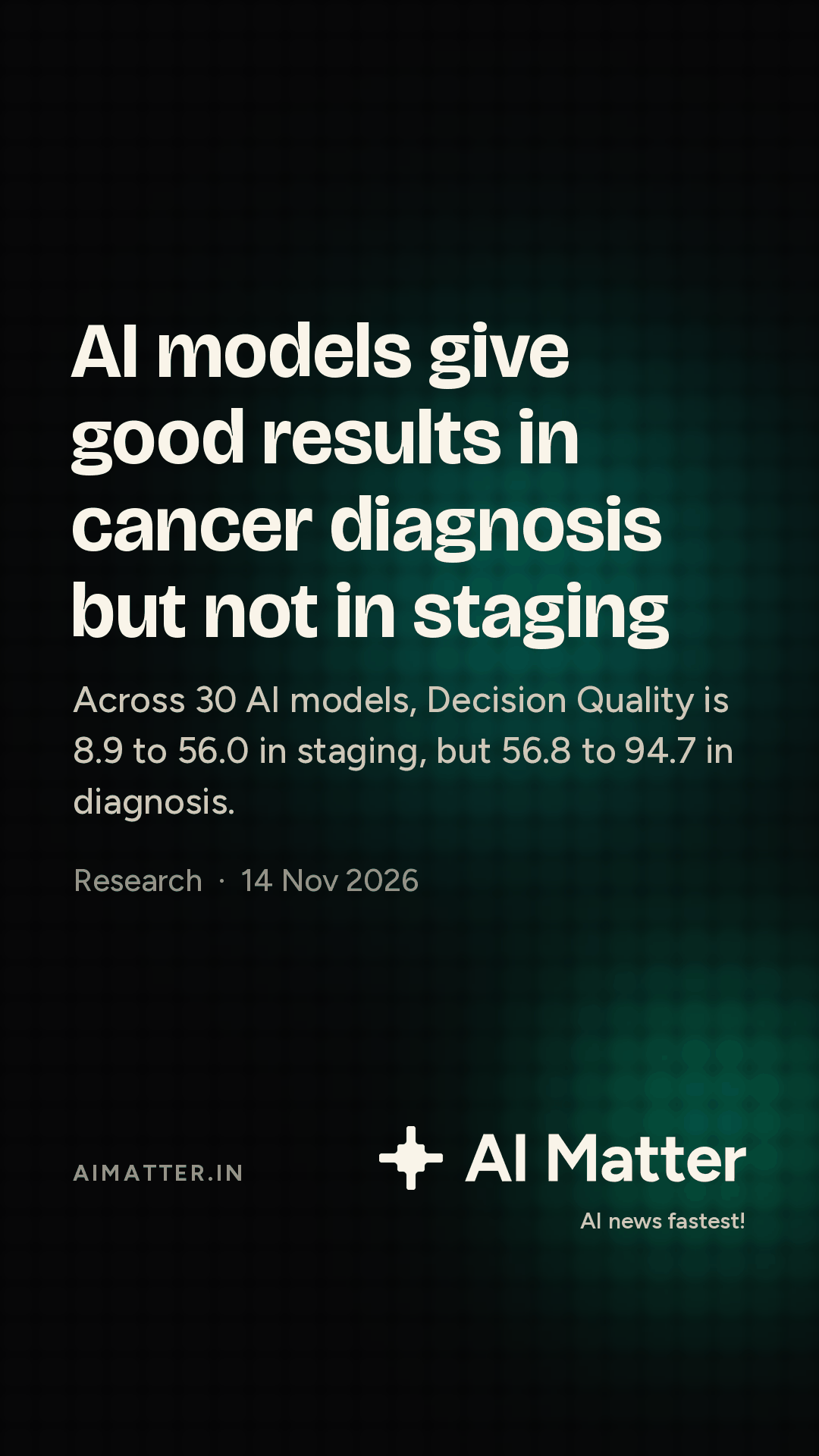
AI models give good results in cancer diagnosis but not in staging
Across 30 AI models, Decision Quality is 8.9 to 56.0 in staging, but 56.8 to 94.7 in diagnosis.
Researchers make NPC-RubricBench, a test of AI models for language for one cancer, nasopharyngeal carcinoma, with records of 405 patients at 2 cancer centers. It has 941 test units in 6 steps, from work-up to follow-up, and 17,688 criteria for each patient. In 30 AI models, strong results in diagnosis do not make sure of good results in subsequent steps.
How it works
Each test unit gives the model only the information from that decision point. The test gives scores on different dimensions. Decision Quality is one of them.
The numbers
Decision Quality for the 30 models is in these ranges:
- Diagnosis: 56.8 to 94.7.
- Staging: 8.9 to 56.0.
- Treatment: 32.4 to 94.2.
Incorrect decisions are the primary type of error in staging, at 48.2%. In work-up and follow-up, the primary error is a decision that the model does not give.
What is not known
Open prompts decrease Decision Quality in all models. Checklist prompts increase it, but they decrease the faithfulness to the information and the safety adherence. The tests in the paper use one cancer. The authors write that other cancers and chronic diseases can use the method.
Insight: One score can hide a loss in safety
The authors write that checklist prompts increase Decision Quality but decrease safety adherence. A related paper writes that a model must have a test for policy, wording, likelihood quality and decision results. Because a vendor can increase one score with a different prompt and decrease a different score, a buyer must not use one total only.
Sources
Posted