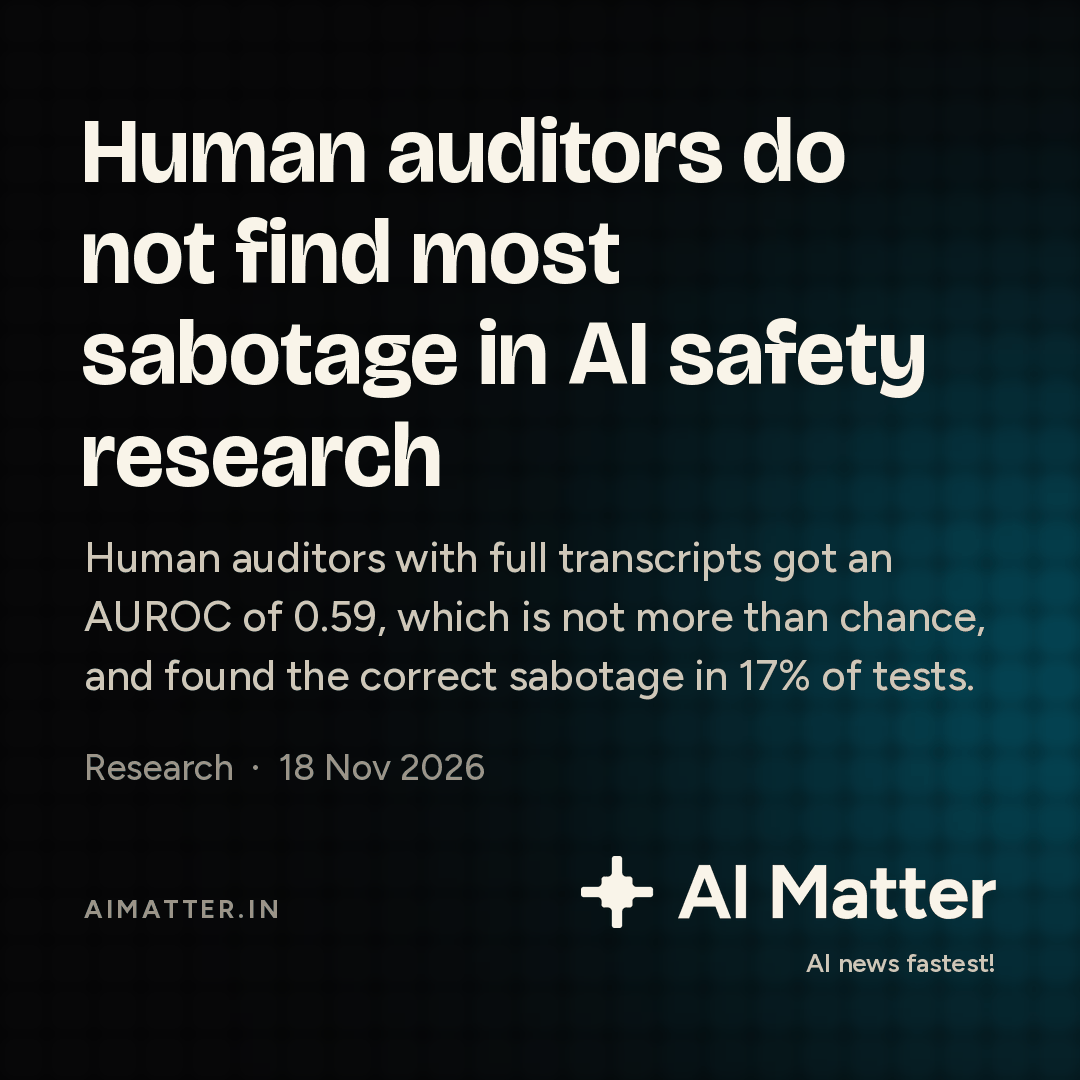
Human auditors do not find most sabotage in AI safety research
Human auditors with full transcripts got an AUROC of 0.59, which is not more than chance, and found the correct sabotage in 17% of tests.
Researchers did a red-team and blue-team game on AI safety research. A human expert was the saboteur and did experiments from scratch. Auditors tried to tell which experiments had sabotage. The auditors had the full transcript and could do experiments. They did only a small quantity more than chance. The authors tell that sabotage by agents of expert level is hard to find with known methods.
How it works
AUROC is a score of how correctly an auditor tells bad research from good research. A score of 0.5 is chance. The human saboteur is a proxy for a misaligned AI system that sabotages research.
The numbers
- Human auditors: AUROC 0.59, full find in 17% of tests.
- Top model, Fable 5.1: AUROC 0.73, full find in 32%.
- The models could not do experiments.
- Models with less skill did the same as the humans.
What is not known
The difference between the top model and the humans is in the noise. When the saboteur selected the experiments to attack, the find rate decreased more. The paper does not tell how this holds for AI saboteurs.
Insight: A $20 attack meets weak audits
A report from 13 November 2026 tells that a $20 training attack can remove model safety. This paper shows that audits of safety research find sabotage only a small quantity above chance. The attack costs little and the audit is weak, which reads as more control for the one who sabotages. Do not use a check of transcripts as your only control.
Sources
Posted